How to Choose Tent Structure: Dome vs Tunnel vs Pyramid
1. The Real Difference Is Not Shape — It’s How the Structure Handles Force
Most people compare tents by shape:
- Dome
- Tunnel
- Pyramid
At a glance, they all seem to do the same job.
But once you start using them in real conditions, especially wind or uneven ground, the differences become very clear.
Some tents stay stable and predictable.
Others feel like they are constantly adjusting, flexing, or losing shape.
This is not about design preference.
It’s about how each structure transfers and controls force

2. A Simple Model: Every Tent Is a Force System
To understand the difference, think of a tent as a system that must do three things:
- Hold its shape
- Transfer external forces (wind, load)
- Maintain usable interior space
The key question is:
👉 Does the force move smoothly through the structure, or does it get trapped and create movement?
3. Dome Tents: Multi-Directional Stability
Dome tents use crossing poles, which create multiple structural paths.
This means:
- Force can travel in different directions
- Load is distributed across the frame
- The structure resists deformation from multiple angles
That’s why dome tents feel:
- Stable
- Predictable
- Forgiving
Even if setup is not perfect, they usually still perform reasonably well.
Why they feel “solid”
Because they have structural redundancy.
If one part takes load, another part shares it.
This is what gives dome tents their “balanced” feel.
Limitation
All this structure requires more material.
- More poles
- More weight
- Less efficient interior volume
4. Tunnel Tents: Efficient but Direction-Dependent
Tunnel tents look simple, but structurally they are very different.
They rely on:
- Parallel poles
- Fabric tension
- Ground anchoring
They do NOT have crossing support.
Why tunnel tents feel spacious
Because the structure is simplified:
- Poles only support in one direction
- Fabric creates the rest of the shape
👉 This allows more usable interior space with less material
The real limitation: single-direction rigidity
Tunnel tents are strong in one direction, and weak in another.
👉 They are designed to resist force along the axis of the tunnel
But across that axis:
👉 There is much less structural resistance
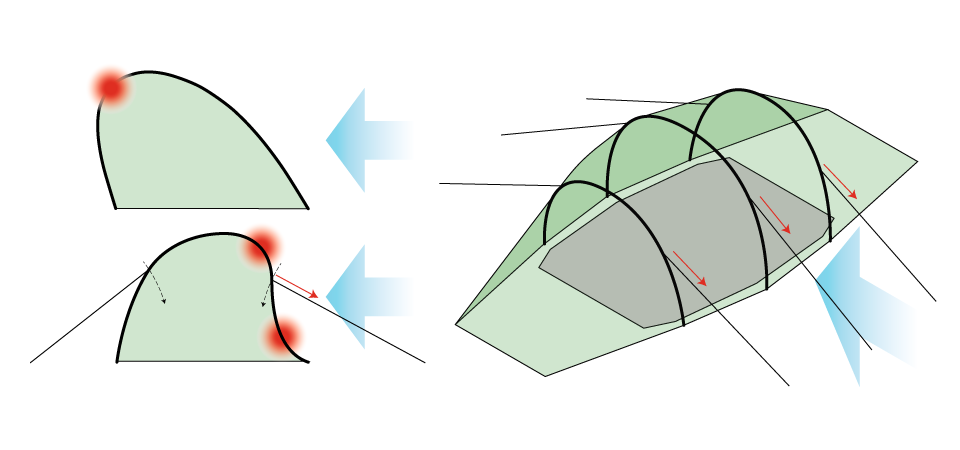
What is the “wrong wind angle”?
Correct wind direction:
👉 Wind hits the narrow end (front or rear) of the tent
This allows:
- Air to flow smoothly over the structure
- Force to be distributed along the poles
Wrong wind direction:
👉 Wind hits the broadside (side wall) of the tent
This creates:
- Large exposed surface area
- Uneven pressure across fabric
- Sideways deformation
In simple terms:
👉 Front/back wind = structure works with the load
👉 Side wind = structure fights the load
Why this matters so much
Because tunnel tents don’t have cross-bracing.
When wind comes from the side:
- Force cannot be redirected efficiently
- Fabric takes more load
- Poles begin to flex sideways
👉 This is when you feel:
- Shaking
- Fabric movement
- Loss of shape
Another key point: dependence on tension
Tunnel tents only work properly when:
- Stakes are solid
- Guylines are tight
- Tension is evenly distributed
Without this:
👉 The structure is incomplete
5. Pyramid Tents: Direct Load Transfer and Structural Simplicity
Pyramid tents are structurally very different.
They rely on:
- A central pole
- Tensioned fabric
- Ground anchoring
Why they are so efficient
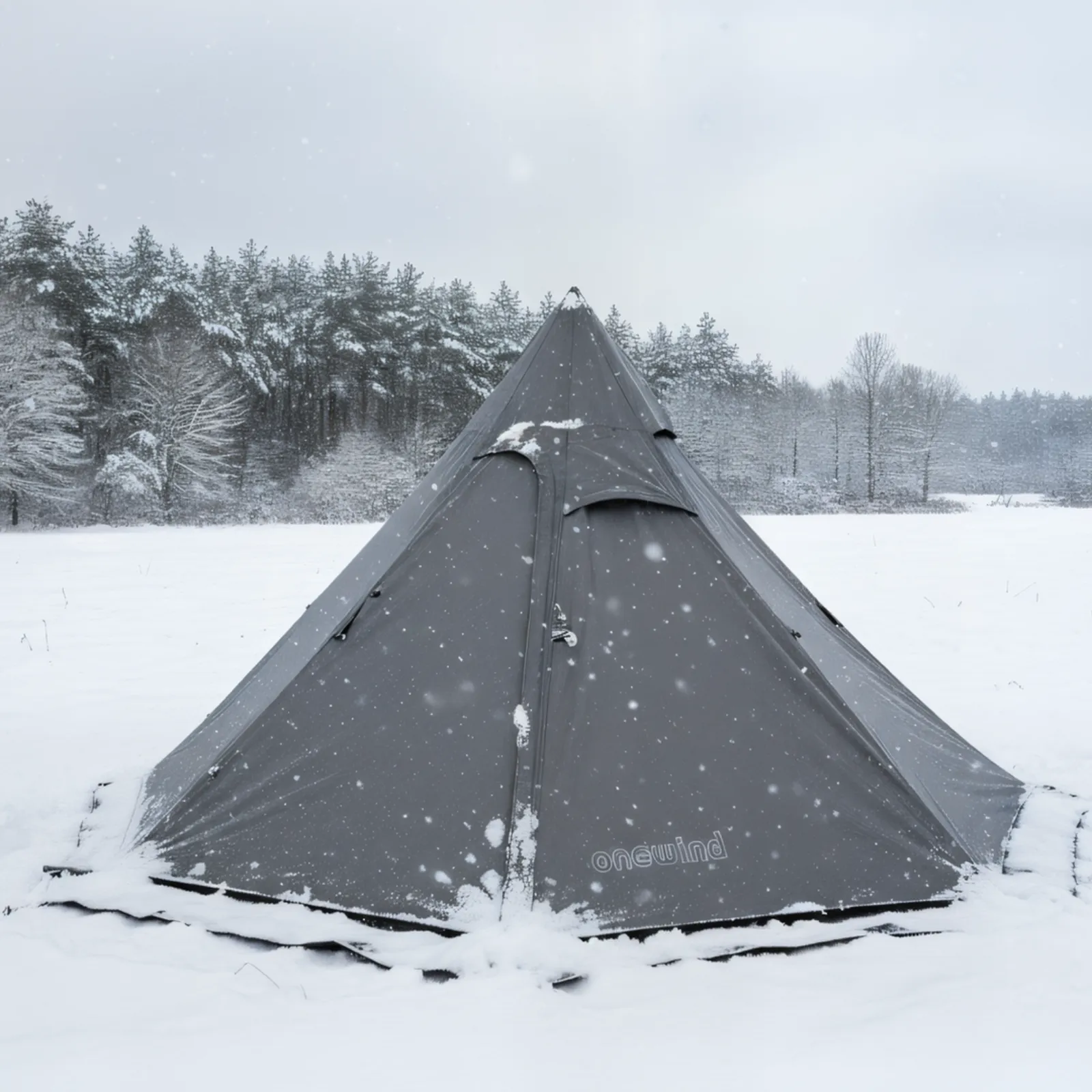
Because force moves in a very direct way:
👉 From fabric → down along the panels → into the ground
There are no complex paths.
No redirection needed.
This creates a very stable system
- Wind is deflected by sloped sides
- Load is guided downward
- Structure remains consistent
Limitations
- Interior space is constrained
- Central pole takes usable area
- Setup requires careful tension balance
6. Why These Differences Feel Huge in Real Use
On paper, all tents provide shelter.
But in practice, the differences show up in how they respond to real conditions.
| Aspect | Dome | Tunnel | Pyramid |
|---|---|---|---|
| Wind Resistance | Distributes force in multiple directions | Stable only along the tunnel axis | Channels force downward to ground |
| Setup | Forgiving, tolerates imperfection | Requires precision and correct orientation | Sensitive to tension balance |
| Interior Space | Stable but less space-efficient | Spacious but condition-dependent | Efficient but constrained |
7. A More Practical Way to Choose
Instead of comparing specs, think in terms of structure behavior.
If you want reliability and ease → Choose Dome
- Works in most situations
- Tolerates imperfect setup
If you want space efficiency → Choose Tunnel
- More livable space
- But requires correct setup and orientation
If you want simplicity and efficiency → Choose Pyramid
- Minimal structure
- High strength-to-weight ratio
- Requires experience
8. Final Thought
These structures are not better or worse.
They are solving the same problem in different ways.
A tent is not just something that stands.
It is a system that:
- Transfers force
- Maintains shape
- Responds to environment
So the real question is not:
👉 “Which tent is best?”
It is:
👉 “Which structure works with how I actually camp?”