Last week, I was camping on an open grass field.
As the wind picked up near sunset, I noticed a beginner nearby struggling to secure his tent. When I walked over, I immediately saw the problem:
- his stakes were driven almost straight down
- the guylines were barely tensioned
- and worst of all, the hook of the stake was facing toward the tent
Everything was working against him.
It reminded me of my early days. One night by Taihu Lake, the wind got stronger than expected. I woke up in the middle of the night to find my tent half-collapsed. By morning, every single stake had been pulled out.
At the time, I thought the stakes weren’t strong enough.
Now I know:
Tent stakes don’t fail because they’re weak —
they fail because the system is misaligned.
A Tent Is a Force System
A tent in wind is not just “standing.”
It’s constantly under force.
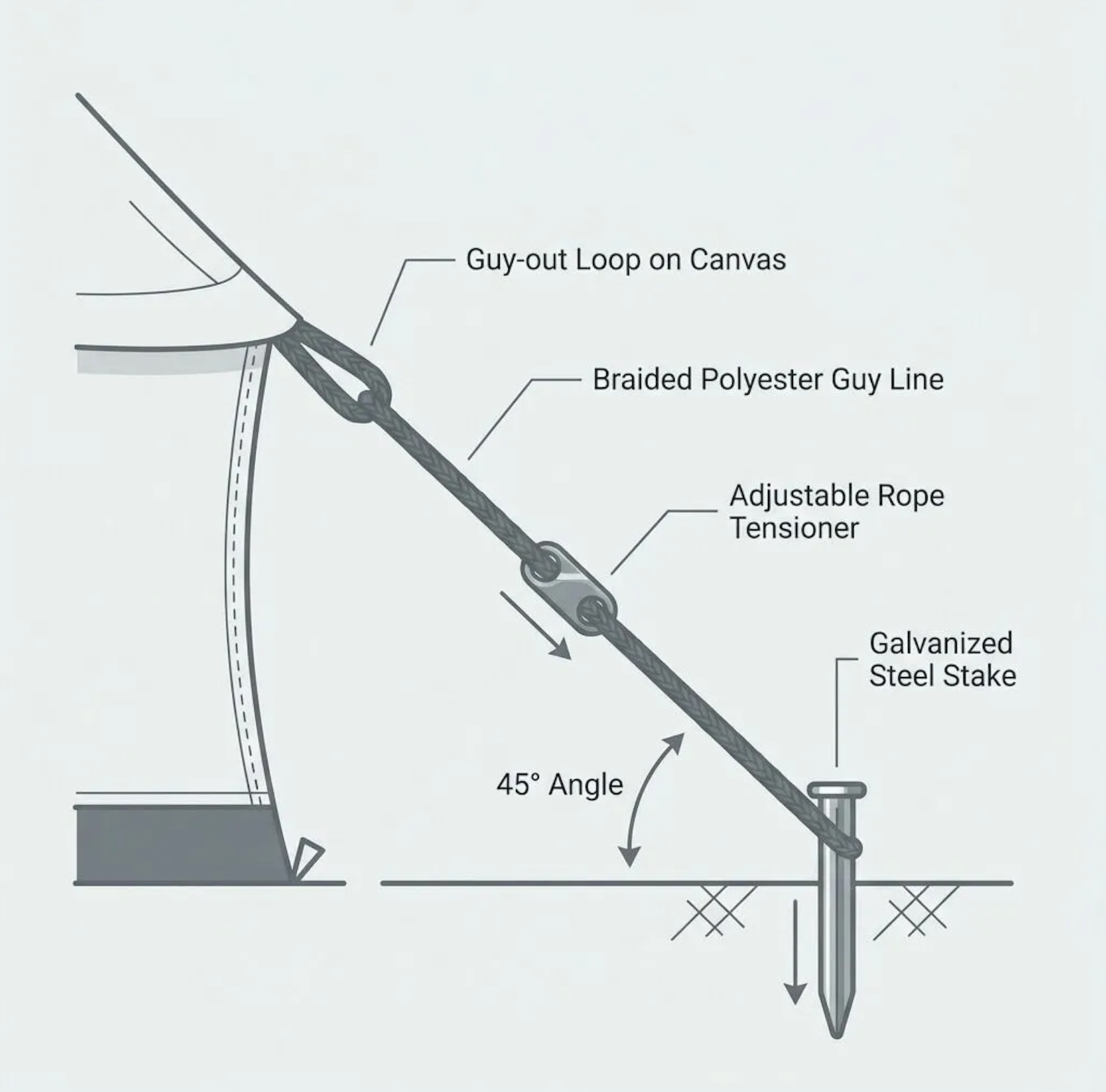
That force travels through a path:
- wind → fabric
- fabric → guyline
- guyline → stake
- stake → ground
This is called the load path.
If any part of that path is weak or misaligned:
👉 the entire system becomes unstable
What Actually Holds a Stake
A stake doesn’t “hold” your tent by itself.
It works because the ground resists the force coming from the guyline.
But that only works if:
the direction of the force and the direction of resistance are aligned
The Hidden Problem: Misalignment
Most beginners focus on:
- how deep the stake is
- how strong the stake is
But the real issue is:
👉 alignment
If the stake is not aligned with the pulling direction:
- part of the force turns into rotation
- soil structure breaks down
- friction drops
Why 45° Works — and When It Doesn’t
You’ve probably heard:
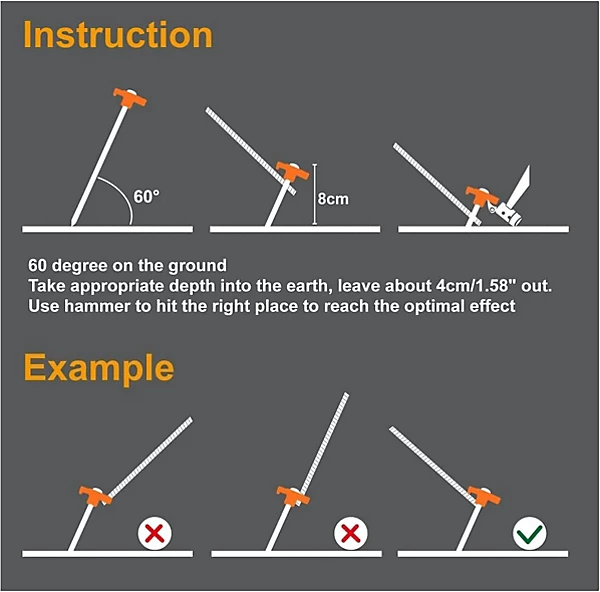
👉 “Drive the stake at 45°”
That works in many cases.
But not because 45° is special.
It works because:
👉 it roughly matches the direction of the guyline pull
45° is a shortcut — not a rule
If your guyline angle changes:
👉 the ideal stake angle changes too
How Stakes Actually Fail (Step by Step)
Failure is not instant.
It’s a process.
Stage 1 — Micro Rotation
The stake starts to twist slightly.
You usually don’t notice this.
Stage 2 — Soil Breakdown
As it rotates:
- surrounding soil loosens
- contact area reduces
Stage 3 — Friction Loss
Less contact → less friction
👉 holding power drops quickly
Stage 4 — Load Transfer
Other stakes take more load.
The system becomes unbalanced.
Stage 5 — Chain Failure
One stake pulls out → others follow
👉 the whole structure collapses
Wind Doesn’t Just Add Force — It Repeats It
Wind introduces:
- oscillation
- repeated loading
- sudden peaks
This matters because:
👉 even small misalignment gets amplified over time
A setup that looks stable at sunset
can fail at 2AM
What Actually Works (With Understanding)
1. Read the Force First
Before placing a stake:
- pull the guyline outward
- observe its natural direction
👉 this is your force line
2. Align the Stake With That Line
- drive the stake along the force direction
- not just “some angle”
3. Use Angle to Increase Ground Resistance
Tilting the stake:
- increases contact with soil
- increases resistance
4. Build a Balanced System
Don’t tighten one corner fully.
👉 tension should be distributed
5. Re-check After Setup
Because:
- soil compresses
- tension shifts
👉 a quick adjustment makes a big difference
Small Detail That Matters: Hook Direction
The hook should face away from the tent.
This:
- aligns with the load direction
- reduces lateral movement
- improves stability
3 Practical Insights
Tip 1 — Rotation Means Failure Has Started
Even slight movement matters.
Tip 2 — Geometry Beats Strength
A well-aligned weak stake
can outperform a strong but misaligned one
Tip 3 — Your Tent Is One System
Not separate parts.
👉 everything shares load
The Real Takeaway
Most people think staking is about strength.
It’s not.
It’s about how force moves through your setup —
and whether the ground can resist it.
Once you understand that:
- 👉 staking becomes predictable
- 👉 not trial and error