Part 1: It’s Not the Wind — It’s Your Setup
A lot of people have the same experience the first time they camp in windy conditions:
The tent doesn’t just move — it keeps shaking, irregularly, all night.
You’ll notice things like:
- Fabric constantly flapping
- Poles flexing slightly
- Guylines going slack, then tight again
- The whole tent almost “breathing”
The natural reaction is:
“The wind is just too strong tonight.”
But after a few trips, a pattern becomes obvious:
Same wind — some tents stay stable, others never stop shaking
That tells you something important:
The problem isn’t the wind. It’s whether your tent is actually forming a stable structure.
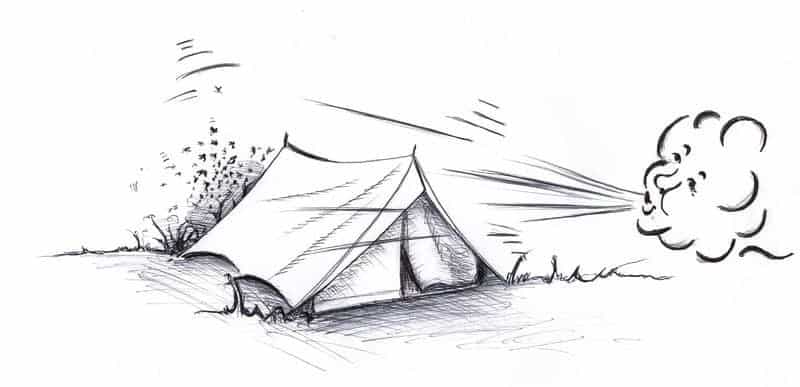
Part 2: Wind Is a Dynamic Load — Not a Steady Push
To understand stability, you need to understand what wind actually does.
1️⃣ Wind Is Not Constant
Wind isn’t a smooth, steady force.
It’s:
- Changing in intensity
- Slightly shifting direction
- Full of turbulence
So your tent isn’t being “pushed” once.
It’s being disturbed continuously.
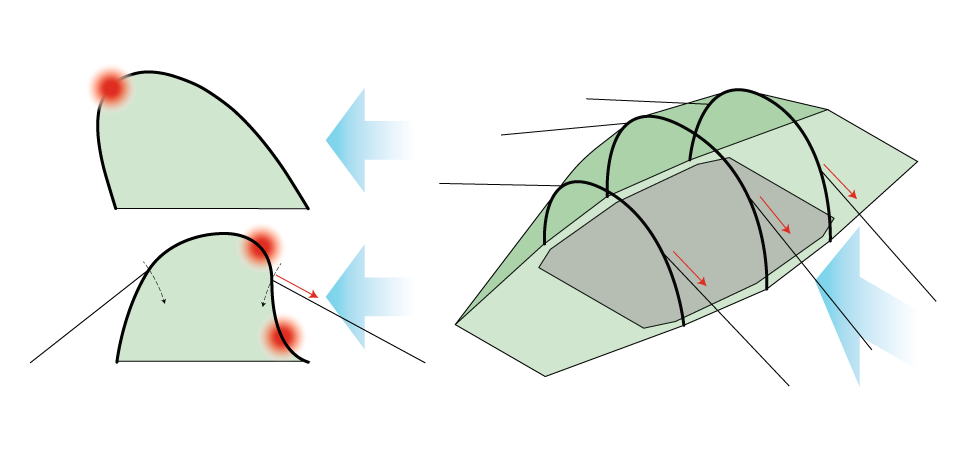
2️⃣ It’s Not Just Pressure — It’s Pressure Difference
When wind flows over your tent:
- Windward side → pressure pushing inward
- Leeward side → suction pulling outward
Your tent is being pushed and pulled at the same time.
3️⃣ Shaking Means the Structure Can’t Settle
If your structure is solid:
Force travels through the system and dissipates into the ground.
If not:
Force gets trapped → builds → releases → repeats
That’s what you’re seeing as: continuous shaking
Part 3: Problem #1 — Lack of Real Tension (The Most Common Issue)
What Most People Get Wrong
Most people think tension means:
“Just pull it tight.”
But real tension means:
The entire fabric surface is under continuous, even load
What Happens When It’s Not
If there’s slack:
- Wind hits → fabric lifts
- No resistance → delayed response
- Fabric snaps back
Result: Flapping cycles
The Real Question
It’s not: Loose vs tight
It’s: Can force travel smoothly across the entire structure?
Think of It This Way
Your tent fabric is: A tensioned membrane
For stability: Force must flow continuously: fabric → guyline → ground
Part 4: Problem #2 — No Force Path
What Is a Force Path?
When wind hits your tent, the force should travel:
Fabric → guylines → ground
What If It Doesn’t?
- Force gets stuck
- Can’t transfer
- Turns into movement
Result: Bulging, vibration, twisting
Common Causes
- No guylines → poles take all the load
- Loose stakes → force has nowhere to go
- Uneven tension → unstable load distribution
This is why a tent can look “set up” but still be: structurally unstable
Part 5: Problem #3 — Guylines Are Structural, Not Optional
Most people treat guylines like accessories.
They’re not.
They are part of the structure.
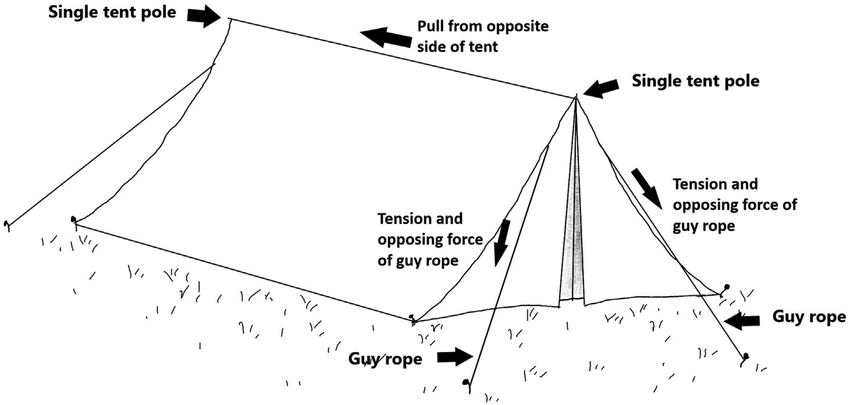
What Guylines Actually Do
1️⃣ Redirect Force
They convert horizontal wind into angled tension
2️⃣ Expand the Base
They widen the effective footprint
3️⃣ Distribute Load
They keep tension consistent across the surface
Skipping guylines means: you’re removing a major part of the structural system
Part 6: Problem #4 — Orientation Matters More Than You Think
A tent is not symmetrical in how it handles wind.
Different sides behave very differently.
Why?
Because: Wind load depends on exposed surface area
Basic Rule
Wind load ≈ wind speed × exposed area
Common Mistake
Facing the largest side into the wind
Result:
- Maximum force
- More deformation
Better Setup
Point the narrow end into the wind
Result:
- Less force
- More stability
This single adjustment often matters more than adding extra guylines.
Part 7: Problem #5 — Ground Anchoring Is Everything
At the end of the chain, everything depends on:
your anchor points
Why?
Because all forces must: end in the ground
If Anchoring Fails
- Force has nowhere to go
- The whole structure becomes unstable
Result:
the entire tent moves
Ground Matters
- Grass → weak hold
- Sand → low resistance
- Hard ground → difficult penetration
Stability isn’t about pushing stakes harder.
It’s about: matching your anchoring method to the ground
Part 8: The Full Model — A System, Not Parts
Your tent works as a system of four elements:
- Poles → shape
- Fabric → receives force
- Guylines → redirect force
- Stakes → release force
Stability depends on: whether these form a continuous loop
Break the loop: You get movement
Part 9: Quick Diagnosis — Why Is Your Tent Shaking?
Check these four things:
- Fabric fully taut?
- All guylines under load?
- Orientation correct?
- Stakes solid?
Fix these, and most shaking disappears.
Part 10: Sound Is a Signal — Not Just Noise
People often think: “It’s just noisy.”
But actually:
Sound tells you what’s wrong
- Flapping → tension issue
- Irregular vibration → structure + wind issue
- Snapping lines → anchoring issue
These are not random.
They’re diagnostics.
Part 11: The Real Principle
A stable tent isn’t about:
- More material
- Heavier build
- Stronger poles
It’s about:
Whether force is being properly redirected
If it is: Stable
If not: Movement
So the real question isn’t: “Is the wind too strong?”
It’s: “Is the force going where it should?”
Part 12: Q&A
Q1: Does strong wind always cause shaking?
No.
A properly structured tent can remain stable in moderate wind.
Q2: I tightened everything — why is it still shaking?
Because:
Direction of force matters more than how tight it feels.
Q3: More guylines = more stability?
Not always.
Placement matters more than quantity.
Q4: Are lower tents always more stable?
Generally yes — but only if:
structure, tension, and orientation are correct