Last weekend, I took my younger sister to a park.
There were tents and tarps everywhere—people enjoying the sun.
But after watching for a while, something stood out.
A lot of setups looked— wrong.
- tarps sagging in the middle
- edges uneven
- structures shifting with even light wind
Some of them looked like they might collapse at any moment.
And the interesting part is:
👉 most of the time, the problem isn’t the tarp or the tent
It’s how the guylines are tensioned.
Guylines Don’t Just Hold — They Shape the Structure
Most people think guylines are just there to “tie things down.”
But that’s not what they really do.
Guylines:
- define the shape of your shelter
- distribute force across multiple points
- create space between layers (important for rain and condensation)
👉 If the tension is wrong:
- your structure loses shape
- load becomes uneven
- stability drops quickly
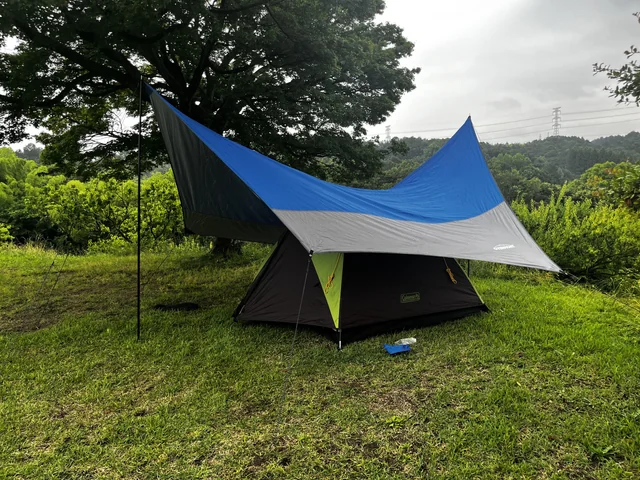
What Tensioners Actually Do
A tensioner doesn’t make your setup stronger.
It gives you control.
Without tensioners:
- you have to rely on knots
- and there are many different ones
At home, they all seem simple.
You watch a video, try it once, and think you’ve got it.
But in the field, it’s different.
- your hands are cold
- it’s getting dark
- the wind is picking up
👉 and suddenly, you can’t remember how to tie it properly
Even if you do:
- adjustments are slow
- you have to untie and redo everything
- so you tend to “set it once and leave it”
With tensioners:
- you can adjust instantly
- fine-tune tension precisely
- respond to changing conditions
👉 The difference isn’t just convenience
It’s whether you can actually adapt your setup when conditions change.
Tensioners turn a fixed setup into an adjustable system.
The Most Common Mistake
Most people do this:
- pull one guyline tight
- lock it
- move on
👉 The result:
- one side takes too much load
- other points are underused
- the structure becomes unstable
Proper Tension Is About Balance
A stable setup is not the tightest one.
It’s the most balanced one.
👉 You want:
- even load distribution
- smooth fabric tension
- no single point overloaded
The Right Way to Tension Guylines
1. Start Loose
After staking:
- leave some slack
- don’t lock everything immediately
2. Adjust Gradually
- tension one line slightly
- move to the next
- come back again
👉 Think of it like tuning, not pulling
3. Watch the Fabric, Not Just the Line
Look at:
- ridgelines
- panels
- overall shape
👉 Clean, smooth lines = correct tension
4. Avoid Over-Tensioning
Too much tension can:
- distort structure
- stress materials
- reduce flexibility in wind
👉 Slight flexibility is good
5. Let It Set — Then Adjust Again
After setup:
👉 come back after 10-15 minutes and adjust again
Because:
- soil settles
- tension redistributes
👉 This alone improves stability more than most gear upgrades
What Changes at Night (Most People Miss This)
Even if everything looks perfect at sunset:
- humidity increases
- temperature drops
- materials begin to relax
👉 This happens in almost every setup, regardless of gear.
Some materials—like nylon—can absorb a small amount of moisture from the air, which may cause slight relaxation in the fabric.
But this is not a flaw.
👉 It’s simply a material characteristic.
In fact, nylon is widely used because it offers:
- excellent strength-to-weight ratio
- high durability
- good packability
👉 What matters is understanding that:
your setup will change over time—and you need to adjust accordingly
This is why a shelter that felt tight in the evening
can start to loosen slightly later at night.
That “sagging” look you sometimes see?
👉 It’s usually not bad setup—it’s just tension loss over time.
You’ve probably seen setups like this:
- center sagging
- edges uneven
- looks like a “pirate ship”
👉 That’s not bad setup—it’s lost tension
Before Sleep: One More Check
Before going to sleep:
- walk around your shelter
- re-tension all guylines
- check overall balance
👉 This prevents most night-time failures
Choosing a Simple Tensioner Setup
You don’t need anything complicated.
For most setups:
- basic plastic tensioners — fine for beginners
- Line Lock style — best for everyday use
- pulley-style — useful for large tarps in wind
👉 The goal is not the device
It’s having a system you can adjust easily.
3 Practical Insights
Tip 1 — Tight ≠ Stable
Overtightening often makes things worse
Tip 2 — Balance Beats Force
Even moderate tension works if it’s evenly distributed
Tip 3 — Adjust the System, Not the Line
If one line is loose:
👉 check the whole structure
The Real Takeaway
Guylines are not about pulling harder.
They control how your shelter holds its shape
and how force is distributed across the system.
Tensioners are what make that control possible.