Your Sleeping Bag Feels Cold — Because Your Heat Can’t Stabilize
A lot of people already know this:
“A tighter sleeping bag is warmer.”
So when they feel cold, they assume:
“Maybe this bag is too big.”
That’s not wrong.
But it’s also not the full explanation.
Because the real issue isn’t just space.
👉 It’s that your body can’t build a stable warm environment inside the bag.
Warmth Is Not Instant — It Has to Build
When you get into a sleeping bag, you’re not immediately warm.
What actually happens is a process:
- Your body produces heat
- That heat warms the air around you
- That warm air is trapped
- A stable “warm layer” forms
Only after this process stabilizes do you feel comfortable.
What Changes When the Space Is Too Large
Now imagine the same process—but inside a larger volume.
Nothing about your body changes:
- same heat output
- same metabolism
But the environment changes:
👉 there is more air to heat
The Key Problem: Heat Can’t Reach Equilibrium
In a well-fitted sleeping bag:
- heat builds quickly
- the air warms up
- a stable temperature forms
In a larger bag:
- heat spreads out
- temperature rises more slowly
- equilibrium is harder to reach
So instead of a stable warm layer, you get:
👉 a constantly shifting temperature field
What This Feels Like (And Why It’s Confusing)
This is why people often say:
“It never really gets warm.”
Not because it’s cold.
But because:
- warmth never stabilizes
- the system keeps losing balance
You might feel:
- briefly warm, then cooler again
- different temperatures in different spots
- no “comfortable zone”
Air Movement Inside the Bag Changes Everything
This is the part most people never think about.
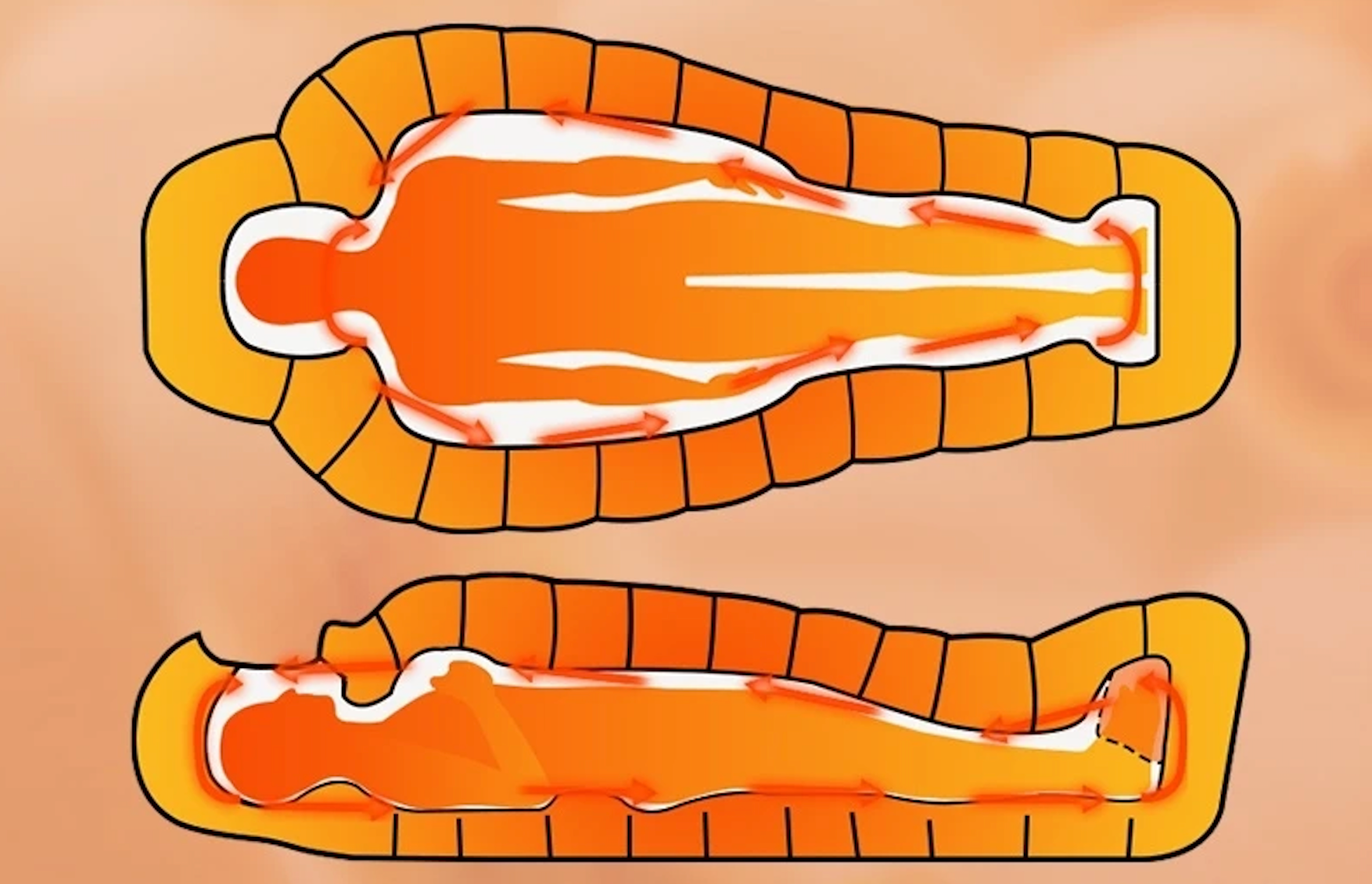
When the internal space is larger:
👉 air starts to move more easily inside the bag
Small Space
- air is mostly still
- heat stays close to your body
- temperature is stable
Large Space
- air circulates when you move
- warm air drifts away
- cooler air replaces it
Why Movement Makes It Worse
Every time you move:
- you disrupt the warm air layer
- you mix warm and cooler air
- you restart the heating process
In a snug bag, this effect is small.
In a large bag:
👉 it becomes noticeable
Why Feet Get Cold First
This is not random.
Feet are usually:
- farthest from your core heat
- located in the largest empty space
So:
- heat arrives later
- air cools faster
- cold accumulates
Real Camp Scenario
You’re using a slightly oversized sleeping bag.
At night:
- you lie down and start warming up
- after a while, you feel okay
Then:
- you move
- shift position
- adjust your legs
And suddenly:
👉 it feels colder again
Nothing changed outside.
👉 the internal system just reset
Why This Is Different From Other “Cold Problems”
This is not:
- ground heat loss
- moisture
- wind
Those are external losses.
This is different:
👉 your system never stabilizes internally
What Actually Helps (Without Replacing Your Bag)
You don’t need to eliminate space.
You need to control it.
1. Reduce Internal Volume Strategically
Focus on areas where heat is lost:
- feet
- sides
- torso gaps
Use:
- clothing
- gear
- soft items
2. Limit Air Movement
- avoid excessive shifting
- keep your position stable
- reduce internal airflow
3. Improve Heat Distribution
- wear balanced layers
- avoid leaving large empty zones
4. Choose Fit Based on Conditions
- colder trips → closer fit
- mild weather → more flexibility
3 Practical Observations
Tip 1 — Warmth Depends on Stability, Not Just Insulation
A stable system feels warmer than a fluctuating one—even at the same temperature.
Tip 2 — “Feels Cold” Often Means “Can’t Stabilize”
If warmth comes and goes, this is usually the reason.
Tip 3 — Internal Air Movement Is an Invisible Factor
You don’t see it.
But you feel it.
The Real Takeaway
This isn’t just about having too much space.
It’s about what that space does to your system:
It prevents your body from building a stable warm environment
Once you understand this, the problem becomes clearer:
- it’s not just insulation
- it’s not just temperature
👉 it’s whether your warmth can settle and stay